


What is CNC ?
In machining, numerical control, also called computer numerical control ,CNC is the automated control of tools by means of a computer.It is used to operate tools such as drills, lathes, mills, grinders, routers and 3D printers. CNC transforms a piece of material (metal, plastic, wood, ceramic, stone, or composite) into a specified shape by following coded programmed instructions and without a manual operator directly controlling the machining operation.
A CNC machine is a motorized maneuverable tool and often a motorized maneuverable platform, which are both controlled by a computer, according to specific input instructions. Instructions are delivered to a CNC machine in the form of a sequential program of machine control instructions such as G-code and M-code, and then executed. The program can be written by a person or, far more often, generated by graphical computer-aided design (CAD) or computer-aided manufacturing (CAM) software. In the case of 3D printers, the part to be printed is "sliced" before the instructions (or the program) are generated. 3D printers also use G-Code.
CNC offers greatly increased productivity over non-computerized machining for repetitive production, where the machine must be manually controlled (e.g. using devices such as hand wheels or levers) or mechanically controlled by pre-fabricated pattern guides (see pantograph mill). However, these advantages come at significant cost in terms of both capital expenditure and job setup time. For some prototyping and small batch jobs, a good machine operator can have parts finished to a high standard whilst a CNC workflow is still in setup.
In modern CNC systems, the design of a mechanical part and its manufacturing program are highly automated. The part's mechanical dimensions are defined using CAD software and then translated into manufacturing directives by CAM software. The resulting directives are transformed (by "post processor" software) into the specific commands necessary for a particular machine to produce the component and then are loaded into the CNC machine.
CNC History
The first CNC machines were built in the 1940s and 1950s, based on existing tools that were modified with motors that moved the tool or part to follow points fed into the system on punched tape. These early servomechanisms were rapidly augmented with analog and digital computers, creating the modern CNC machine tools that have revolutionized machining processes.
|
CNC Machine |
Description |
|
Mill |
Translates programs consisting of specific numbers and letters to move the spindle (or workpiece) to various locations and depths. Can either be a Vertical Milling Center (VMC) or a Horizontal Milling Center, depending on the orientation of the spindle. Many use G-code. Functions include: face milling, shoulder milling, tapping, drilling and some even offer turning. Today, CNC mills can have 3 to 6 axes. Most CNC mills require placing the workpiece on or in them and must be at least as big as the workpiece, but new 3-axis machines are being produced that are much smaller. |
|
Lathe |
Cuts workpieces while they are rotated. Makes fast, precision cuts, generally using indexable tools and drills. Effective for complicated programs designed to make parts that would be unfeasible to make on manual lathes. Similar control specifications to CNC mills and can often read G-code. Generally have two axes (X and Z), but newer models have more axes, allowing for more advanced jobs to be machined. Most modern lathes have live tooling, allowing for limited milling operations to take place without having to remove the part from the lathe spindle. Second operations can be completed by using a sub-spindle, which is co-axial to the main spindle, but faces the other direction. This allows the part to be removed from the main spindle, and for additional features to be machined in the back side of the part. |
|
Electric discharge machining |
(EDM), also known as spark machining, spark eroding, burning, die sinking, or wire erosion, is a manufacturing process in which the desired shape is obtained using electrical discharges (sparks). Material is removed from the workpiece by a series of rapidly recurring current discharges between two electrodes, separated by a dielectric fluid and subject to an electric voltage. One of the electrodes is called the tool electrode, or simply the "tool" or "electrode", while the other is called the workpiece electrode, or "workpiece". |
|
EDM can be broadly divided into "sinker" type processes, where the electrode is the positive shape of the resulting feature in the part, and the electric discharge erodes this feature into the part, resulting in the negative shape, and "wire" type processes. Sinker processes are rather slow as compared to conventional machining, averaging on the order of 100mm3/min,[9] as compared to 8x106 mm3/min for conventional machining, but it can generate features that conventional machining cannot. Wire EDM operates by using a thin conductive wire, typically brass, as the electrode, and discharging as it runs past the part being machined. This is useful for complex profiles with inside 90 degree corners that would be challenging to machine with conventional methods. |
|
|
Multi-spindle machine |
Type of screw machine used in mass production. Considered to be highly efficient by increasing productivity through automation. Can efficiently cut materials into small pieces while simultaneously utilizing a diversified set of tooling. Multi-spindle machines have multiple spindles on a drum that rotates on a horizontal or vertical axis. The drum contains a drill head which consists of several spindles that are mounted on ball bearings and driven by gears. There are two types of attachments for these drill heads, fixed or adjustable, depending on whether the center distance of the drilling spindle needs to be varied. |
|
Plasma cutter |
Involves cutting a material using a plasma torch. Commonly used to cut steel and other metals, but can be used on a variety of materials. In this process, gas (such as compressed air) is blown at high speed out of a nozzle; at the same time, an electrical arc is formed through that gas from the nozzle to the surface being cut, turning some of that gas to plasma. The plasma is sufficiently hot to melt the material being cut and moves sufficiently fast to blow molten metal away from the cut. |
|
Punch press |
Used to rapidly punch holes and cut thin materials. Such as sheet metal, plywood, thin bar stock, and tubing. Punch presses are generally used when a CNC mill would be inefficient or unfeasible. CNC punch presses can come in the C frame, where the sheet material is clamped onto a machining table and a hydraulic ram pushes down on the material, or they can come in a portal frame variant where bar stock/tubing is fed into the machine. |
|
Water jet cutter |
Also known as a "waterjet", is a tool capable of slicing into metal or other materials (such as granite) by using a jet of water at high velocity and pressure, on the order of 60,000 PSI, or a mixture of water and an abrasive substance, such as garnet powder. It is often used during the fabrication or manufacture of parts for machinery and other devices. Waterjet cutting is the preferred machining method when the materials being cut are sensitive to the high temperatures generated by other methods. It has found applications in a diverse number of industries from mining to aerospace where it is used for operations such as cutting, shaping, carving, and reaming. The thickness of material processable via waterjet machining is generally limited by the pressure of the waterjet, and by the dispersion of the jet as it gets further from the nozzle. Some waterjet cutters have a 5-axis cutting head, allowing for much more complex shapes to be cut, and to compensate for the angle of the kerf to leave the angled wall on the stock instead of on the finished part. |
Product Description
|
Surface Treatment |
Hot/cold dip galvanized; plating; powder coating;Sandblasting; Anodizing color; Blackenning; Polishing; Brushing |
|||
|
Service |
OEM/ODM CNC machining |
|||
|
Drawing Format |
Pro/E, AutoCAD, SOLIDWORK,CAD, STP, IGES, etc. |
|||
|
Precision Tolerance: |
±0.01mm-±0.05mm |
|||
|
Quality Control |
Strict quality assurance and inspection processes |
|||
|
Machining Process |
Milling, turning, drilling, tapping and sheet metal fabrication Stamping die-casting,Multistep machining |
|||
|
Production Volume |
Low to medium volume, prototype, and batch production |
|||
|
Certificates |
ISO9001:2008,SGS |
|
CNC Material We Use |
|
|
Aluminum |
AL6061, AL6063, AL6082, AL7075, AL5052, A380, etc |
|
Stainless Steel |
303, 304, 304L, 316, 316L, 410, 420, 430, etc |
|
Steel |
Mild Steel, Carbon Steel, 1018, 1035, 1045, 4140, 4340, 8620, XC38, XC48, E52100, Q235, SKD11, 35MF6Pb, 1214, 1215, etc |
|
Brass |
HPb63, HPb62, HPb61, HPb59, H59,H68, H80, H90, etc |
|
Copper |
C11000, C12000, C22000, C26000, C28000, C36000 |
|
Titanium Alloy |
TC1, TC2, TC3,TC4, etc |
|
Iron |
A36,45#, 1213, etc |
|
Plastic |
ABS, PVC,PMMA,PPSU,PTFEPC, PP, PE, POM, Delrin, Nylon, Teflon, PEEK, PEI, etc |
Company Profile

The Business Scope
Company Scale: Founded in 2004, the total assets of 20 million RMB. Covers an area of about 10000 square meters, owns more than 150 employees. Annual turnover of about 50 million RMB;
Zinc, aluminum alloy die-casting mold development and production.
Zinc, aluminum alloy die casting parts;
CNC computer gongs, precision machining, CNC CNC machining center, drilling, tapping, punching machine, batch of feng, grinding and polishing machining
Surface treatment (fully automatic dust-free workshop electrostatic spray, spray powder, sand blasting, vibration grinding, etc.
One-stop processing services!
The company has passed ISO9001:2008 quality system certification.
Recommend Products

Test Equipment


Packing & Delivery
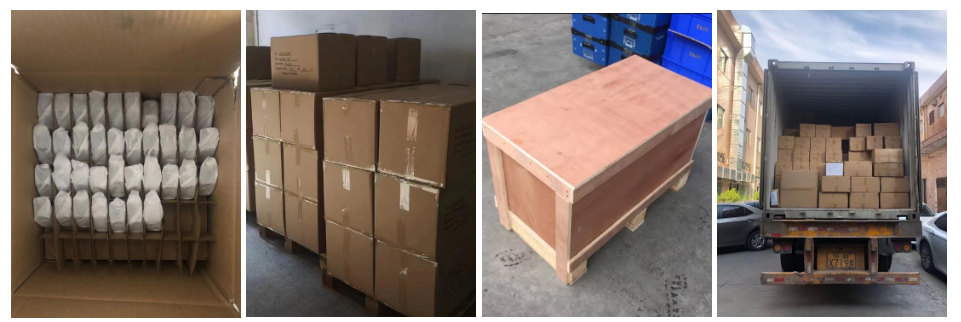
Bubble bag & Cardboard K=K Carton Box Pallet/ Wooden Box

FAQ
Hot Tags: 6061 aluminum CNC mill, China 6061 aluminum CNC mill manufacturers, suppliers, factory, Esports Metal Keyboard, Aluminum Motorcycle Parts, Aluminium Alloy Hookah, CNC Machining Aluminum Motorcycle Parts, CNC Machining Bicycle Brake Disc, Aluminum Speaker


