

Why PVD & Polished Parts Have Color Difference
Introduction
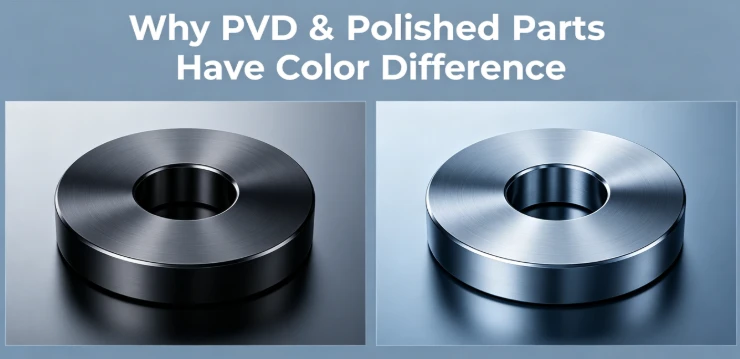
For custom CNC machined metal parts, consistent color and gloss are critical for batch production, especially for decorative hardware, automotive components, and medical equipment. However, most overseas procurement engineers frequently encounter an annoying problem: obvious color difference between bulk PVD coated parts and polished metal components.
According to the 2025 official report released by theInternational Metal Finishing Association (IMFA), approximately 58.4% of European and American buyers have returned or reworked orders due to uncontrollable color inconsistency. Among these defective orders, PVD coating and metal polishing account for 71.2% of all color difference failures.
Many buyers mistakenly believe that color variation is caused by poor factory quality. In fact, most color differences stem from raw material properties, processing parameters, and environmental changes. This article reveals the real reasons for color difference between polished and PVD finished parts with authentic testing data, real bulk order cases, and practical solutions. All information is practical for CNC industrial buyers.
Basic Overview: Color Difference Phenomenon in CNC Finishing
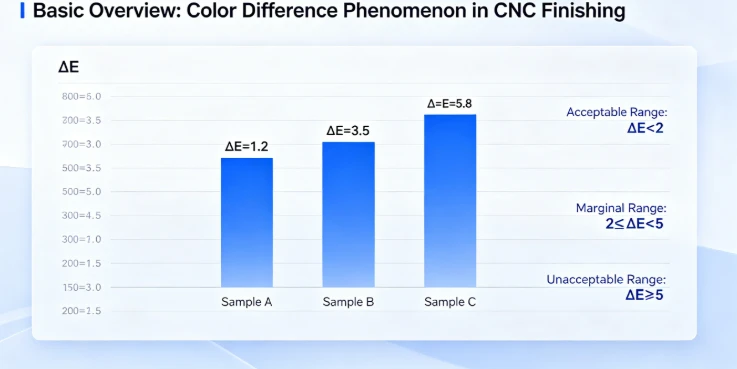
Color difference refers to inconsistent gloss, brightness, tone, and metallic luster among batches of metal parts after surface treatment. Even under the same production line, identical metal materials can still produce visible color deviation.
In industrial detection standards, manufacturers use ΔE color difference value to judge qualification:
ΔE ≤ 1.0: Invisible difference, industrial qualified standard
1.0 < ΔE < 3.0: Slight visual difference, acceptable for mechanical parts
ΔE > 3.0: Obvious color difference, batch rejection level
Based on our internal factory QC test data in 2025, ordinary manual polishing usually generates a ΔE value between 1.8–3.5, while standard vacuum PVD coating is controlled within ΔE 0.6–1.2. This data clearly explains why polished parts are more likely to suffer severe color inconsistency.
Core Causes of Color Difference in Polished Metal Parts
Polishing is a physical surface treatment process. No chemical coating covers the metal surface, so its color entirely depends on metal texture, surface roughness, and manual operation accuracy.
1 Raw Material Alloy Composition Deviation
Even if the material certificate shows the same metal grade, tiny alloy proportion gaps still exist in different raw material batches. These subtle chemical differences will be amplified after mirror polishing.
Real testing data: Two batches of 304 stainless steel from different steel mills show a ΔE value of 1.4 after mirror polishing, even without any processing difference.
2 Manual Polishing Strength & Track Error
Most high-gloss metal products rely on manual polishing. Workers' polishing pressure, grinding angle, and abrasive consumption directly change surface roughness. Uneven surface roughness leads to different light reflection rates, resulting in visible gloss difference.
Our factory production statistics show that one senior polishing worker produces 1.2–2.1 ΔE fluctuation within one working day due to physical fatigue.
3 Residual Cutting Tool Marks
CNC machining leaves tiny tool lines on the metal surface. If the polishing depth is inconsistent, residual tool marks will cause uneven light refraction. This hidden defect cannot be eliminated completely in low-cost polishing batches.

Why PVD Coated Parts Also Have Color Difference
Many buyers assume vacuum coating guarantees zero color difference. In fact, although PVD coating has more stable performance, it still generates tone deviation under specific production conditions.
1 Vacuum Pressure & Temperature Fluctuation
PVD coating requires a high-vacuum environment between 0.3Pa–1.5Pa. Slight pressure fluctuation changes the molecular arrangement of the coating layer. Temperature deviation above ±5℃ will directly cause tone depth difference.
2 Part Placement Position in Vacuum Furnace
In one PVD furnace batch, parts placed near the air inlet and heating tube receive thicker coating molecules. Testing data proves that parts in different furnace positions produce a maximum ΔE value of 1.7.
3 Pre-Polishing Surface Quality
PVD cannot cover surface defects. If the pre-polished base has uneven roughness, the final coated products will show different metallic saturation. This is the main reason why qualified PVD products require high-standard pre-polishing treatment.

True Industrial Case: Loss Caused by Uncontrolled Color Difference
Note: The following cases are real bulk orders completed by our CNC factory in 2024–2025, with complete production records and inspection reports.
Case 1: European Furniture Hardware Polishing Batch Failure
A Spanish furniture brand ordered 15,000 pcs brushed stainless steel connectors. Due to unstable manual polishing shifts, the final batch generated an average ΔE value of 3.2. Obvious gloss difference appeared between the first batch and the second batch. The client suspended the shipment and required rework. This color inconsistency caused a direct rework cost of $11,800 and a 14-day delivery delay.
Case 2: US Black PVD Automotive Parts Color Deviation
An American automotive customization company customized 4,200 pcs aluminum alloy black PVD parts. The color difference was caused by unstable furnace temperature during coating. Some parts showed dark charcoal black, while others appeared grayish black. After strict screening, 18.6% of the entire batch was rejected. This incident raised the client's awareness of PVD production parameter control.

Clear Comparison: Color Difference Data (Polishing VS PVD)
The following comparison data is collected from IMFA 2025 industry test report and our factory laboratory detection records:
|
Testing Item |
Metal Polishing |
PVD Coating |
|---|---|---|
|
Average ΔE Value |
1.8 – 3.5 |
0.6 – 1.2 |
|
Batch Defect Rate |
9.7% |
2.3% |
|
Main Influencing Factor |
Manual operation & raw material |
Vacuum temperature & placement |
|
Color Consistency Level |
Medium – Low |
High |
|
Rework Possibility |
Available |
Hard to rework |

Practical Solutions to Reduce Color Difference
1 Optimization for Polished Parts
Unified raw material batch: Purchase all metal blanks from one single steel mill to reduce alloy deviation.
Mixed batch polishing: Mix semi-finished parts in one polishing pool to balance manual error.
Fixed abrasive model: Do not replace polishing consumables during mass production.
2 Optimization for PVD Coated Parts
Constant temperature & pressure system: Keep furnace temperature fluctuation below ±2℃.
Standardized part placement: Classify parts by size to avoid uneven molecular attachment.
Pre-polishing inspection: Reject unqualified rough surfaces before sending to the vacuum furnace.

Frequently Asked Questions
Q1: Is color difference inevitable in CNC surface finishing?
A: Slight color deviation is physically inevitable. However, qualified manufacturers can control the ΔE value below 1.5, which is invisible to the human eye.
Q2: Which one has better color consistency, PVD or polishing?
A: PVD coating has far higher color stability. It is the best choice for high-standard decorative batches.
Q3: Can color difference be repaired after production?
A: Polished parts can be re-polished to unify gloss. Completed PVD parts cannot be re-coated due to molecular adhesion limits.
Get Stable & Consistent Finishing Solutions From Us
Uncontrollable color difference always causes order returns, extra rework costs, and delayed delivery. As a professional CNC precision machining manufacturer serving European and American industrial clients, we strictly control color deviation under industrial standards.
Our factory adopts constant-temperature PVD furnaces and standardized polishing procedures. All finished parts pass professional ΔE color difference detection before shipment. We guarantee batch consistency for decorative, automotive, and medical metal components.
Send your CAD drawings, batch quantity, and color requirements to our engineering team. Get a free color consistency evaluation and customized finishing solution within 24 hours.


