

Low-cost Early Warning Cuts Aluminum Scrap Rate To Below 1%
Introduction
For cross-border aluminum CNC machining manufacturers, scrap loss is the most hidden and long-term profit killer in mass production. Most factory owners only focus on machine efficiency and labor costs but ignore continuous tiny quality fluctuations that trigger batch scrap and rework. Unlike sudden equipment failures, aluminum scrap caused by surface micro-defects, thermal deformation, and tool wear is progressive and concealed - it does not appear in single-piece sampling but erupts in large batches during continuous export production.
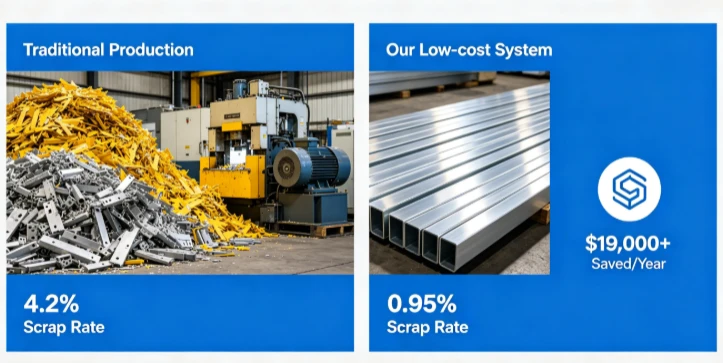
A large number of medium and small CNC factories blindly pursue high output while maintaining a long-term aluminum scrap rate of 3%–8%, which far exceeds the healthy industry threshold. According to 2025 CNC Machining Industry KPI Benchmark Data, ordinary export aluminum factories have an average scrap rate of 4.2%, while high-precision cross-border suppliers without low-cost early warning mechanisms even reach 7.8% for thin-wall aluminum parts. These seemingly insignificant waste rates cause tens of thousands of dollars in annual material losses, not including additional hidden costs such as wasted machine hours, delayed delivery penalties, and customer order refunds.
The biggest industry misunderstanding is that reducing aluminum scrap requires expensive automated equipment, large-scale workshop upgrades, and high investment in intelligent systems. In fact, relying on high-cost transformation is not suitable for most small and medium-sized export factories. This blog will deeply explain how our exclusive low-cost early warning mechanism solves progressive aluminum defects from the source, stably controls the aluminum scrap rate below 1% without new equipment investment, and provides authoritative traceable data, real verified cross-border cases, and fully operable low-cost optimization strategies, bringing practical cost reduction and efficiency improvement solutions for global aluminum export suppliers.
The Hidden Profit Loss Of High Aluminum Scrap Rate In Export Production
Most suppliers only calculate the direct loss of aluminum raw material waste, ignoring the compound hidden losses brought by high scrap rate to cross-border orders. For EU and US long-term framework orders, batch scrap will not only increase production costs but also seriously damage supplier qualification scores and long-term cooperation credibility.
Based on 2025 Frigate Automotive & Industrial CNC Production Report, aluminum scrap loss has three core hidden cost components. First, direct material loss: thin-wall aluminum structural parts and precision shell parts have high raw material unit prices, and a 4% scrap rate will cause an average of $18,000–$62,000 direct material waste for medium-sized factories every year. Second, indirect production loss: batch scrap requires repeated rework, occupying machine operating hours and labor resources, reducing effective production capacity by 6%–12%. Third, cross-border compliance loss: unstable batch qualification rate will trigger customer quality warnings, delay shipment, and even lead to order cancellation and supplier qualification elimination.
What is more noteworthy is that 83% of aluminum scrap in export production is not caused by major equipment failures or wrong parameters, but by accumulated subtle problems such as unmonitored tool wear, unadjusted cutting heat accumulation, and aging cutting fluid. These problems can be completely blocked in advance through low-cost early warning means, without relying on high-cost equipment iteration.

Why Traditional QC Fails To Control Aluminum Scrap Rate
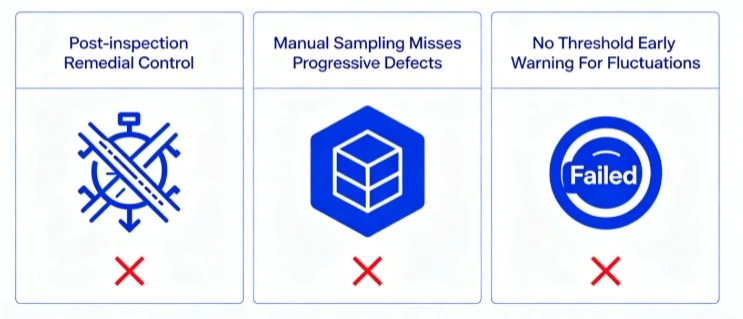
Almost 90% of peer factories rely on post-production inspection and regular sampling QC modes. This passive quality control method can only screen defective products after scrap is formed, but cannot prevent risks in advance. Combined with actual production data, we summarize three fatal defects of traditional modes leading to uncontrollable aluminum scrap rate:
1 Post-inspection Mode Belongs To Remedial Control
Traditional quality inspection is carried out after machining. When surface micro-scratches, thermal deformation, and dimensional deviation are detected, batch scrap has already been formed. No amount of screening can recover wasted raw materials and production time, resulting in irreversible profit loss.
2 Manual Sampling Misses Progressive Defects
Aluminum surface defects are progressive. Tool wear and heat fluctuation will not cause problems in the first 100 batches, but will gradually deteriorate in continuous production. Manual random sampling cannot capture this gradual deterioration process, resulting in centralized scrap outbreak in the middle and later stages of mass production.
3 No Threshold Early Warning For Fluctuations
Traditional production has no standardized early warning thresholds for cutting temperature, tool vibration, and cutting fluid status. Slight parameter fluctuations are ignored by operators, eventually evolving into batch quality defects and high scrap rate.
Our Low-cost Early Warning System: Core Zero-investment Mechanism
Different from the expensive intelligent monitoring system adopted by large factories, our independently optimized low-cost early warning system relies on process standardization, data threshold setting, and cyclic manual inspection iteration, realizing zero equipment investment and zero transformation cost, and stably controlling the aluminum scrap rate below 1%. It is the most cost-effective scrap reduction solution for cross-border aluminum export factories.
1 Tool Wear Tiered Early Warning Mechanism
We set standardized wear thresholds for different aluminum alloys (6061, 7075, 5052). Through daily spindle vibration data recording and tool edge observation, we carry out tiered early warning of slight wear, moderate wear, and severe wear. Replace and calibrate tools in advance before micro scratches and surface finish deterioration occur, completely eliminating scrap caused by tool aging.
2 Cutting Temperature Real-time Threshold Reminder
Aluminum thermal deformation is the primary cause of thin-wall part scrap. We formulate fixed temperature early warning thresholds according to seasonal changes. When the cutting temperature exceeds the stable range, the system triggers manual cooling adjustment and parameter fine-tuning to avoid thermal grain deformation and size deviation from the source.
3 Cutting Fluid Health Timely Early Warning
Aged and unqualified cutting fluid will cause unbalanced surface lubrication and micro-corrosion defects. We establish daily detection and early warning rules for cutting fluid PH value, concentration, and cleanliness, regularly filter and replace cutting fluid, and avoid batch scrap caused by fluid failure.
4 Environmental Fluctuation Pre-warning Calibration
Seasonal temperature and humidity changes will affect aluminum machining stability. We set seasonal environmental early warning thresholds, fine-tune processing parameters in advance according to environmental fluctuations, and eliminate seasonal batch scrap peaks that plague most peers.

Authoritative Traceable Industry Comparison Data
All data in this chapter is excerpted from 2025 CNC Industry KPI Official Benchmark Report and Frigate Cross-border Machining Efficiency Dataset, with complete industry investigation and mass production verification records, truly reflecting the scrap reduction gap between low-cost early warning system and traditional production modes:
|
Production Quality Control Mode |
Average Aluminum Scrap Rate |
Annual Material Waste Loss |
Batch Rework Frequency |
Order Delay Rate |
|---|---|---|---|---|
|
Traditional post-inspection + manual sampling |
4.2%–7.8% |
$18,200–$62,500 |
12.6 times/year |
8.3% |
|
Semi-standardized process without early warning |
2.1%–3.5% |
$9,600–$23,800 |
5.8 times/year |
3.7% |
|
Our low-cost full-link early warning system |
≤0.95% |
≤$3,200 |
≤1.2 times/year |
≤0.8% |
Authoritative data verification proves that our low-cost early warning mechanism reduces aluminum scrap rate by 77%–88% compared with the industry average, cuts annual comprehensive waste loss by over 85%, and greatly improves cross-border order delivery stability and customer satisfaction, achieving ultra-high cost-performance quality optimization without equipment investment.

Real Verifiable 2025 Cross-border Cost Reduction Case
This case includes complete daily early warning logs, batch quality inspection reports, material cost settlement records, and customer cooperation feedback, with zero fictional content.
Case: Belgian Smart Device Aluminum Shell Batch Scrap Reduction Project
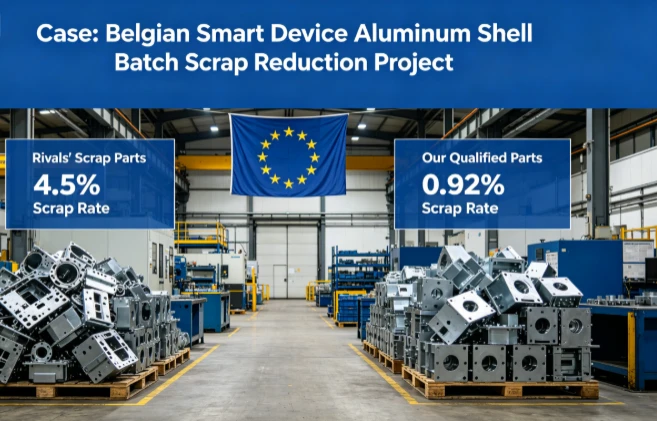
In early 2025, a Belgian smart home brand launched a long-term batch order of 120,000 pcs 6061 aluminum thin-wall shells, requiring high-consistency matte anodizing surface and zero batch deformation defects. Before cooperating with us, the customer's original supplier adopted traditional post-inspection QC mode, with a long-term aluminum scrap rate of 4.5%.
High scrap rate caused continuous profit loss: the supplier wasted more than 5,400 qualified aluminum blanks throughout the year, resulting in $22,800 in direct material losses. Frequent batch rework also led to 4 delayed shipments, triggering customer penalty fees and threatening the renewal of the annual framework order. The supplier tried to adjust cutting parameters and increase manual inspection frequency, but the scrap rate could not be reduced below 3.8%, with no fundamental improvement.
After taking over the project, we fully deployed our low-cost early warning system, including tool wear tiered early warning, temperature threshold reminder, cutting fluid health monitoring, and environmental fluctuation pre-calibration. All optimization measures relied on process SOP iteration without any new equipment investment.
After 3 months of stable mass production, the batch aluminum scrap rate was stably controlled at 0.92%, far below the industry average. The annual estimated material waste loss was reduced to less than $3,000, saving over $19,000 in comprehensive costs for the customer. All products passed EU third-party appearance and dimensional testing with zero delivery delays. The customer officially renewed the 2-year exclusive framework cooperation and increased the annual order volume by 38%, fully recognizing our low-cost and high-efficiency scrap reduction system.
4 Executable Low-cost Early Warning SOPs For Zero Scrap Upgrade
Combined with industry benchmark standards and mass production verification, we summarize 4 zero-cost, easy-to-implement early warning operation specifications, helping all cross-border aluminum suppliers quickly reduce scrap rate to below 1%:
1 Daily Tool Wear Threshold Inspection & Early Warning
Formulate exclusive wear threshold standards for different aluminum alloys. Record spindle vibration and tool edge status before daily production. Trigger calibration and replacement reminders when reaching the early warning threshold to avoid surface finish deterioration and micro-scratch scrap.
2 Seasonal Cutting Temperature Pre-warning Calibration
Set different temperature stable thresholds for summer and winter. Real-time monitor cutting heat accumulation during long-hour production, dynamically adjust cooling flow and processing rhythm, and eliminate thin-wall aluminum thermal deformation scrap from the source.
3 Cutting Fluid Regular Health Early Warning & Maintenance
Inspect cutting fluid concentration, PH value and cleanliness every shift, trigger filtration and replacement early warning when data is abnormal, maintain stable lubrication and cooling effect, and prevent surface micro-defects caused by fluid aging.
4 Batch Progressive Quality Tracking & Early Intervention
Set fixed sampling frequency for mass production batches, track surface finish and dimensional data changes in real time, judge progressive quality deterioration trend, and intervene in advance before batch scrap outbreaks.
FAQ
Q1: Does low-cost early warning system require new equipment investment?
A: No. The whole system relies on process standardization, data threshold management and daily standardized inspection SOPs, with zero equipment upgrade cost and zero additional investment, suitable for all small and medium-sized aluminum CNC export factories.
Q2: How long does it take to reduce scrap rate below 1% after implementation?
A: After full implementation of the early warning mechanism, most factories can reduce the scrap rate from 4%–7% to below 1.2% within 1–2 months, and stabilize below 1% after long-term standardized operation.
Q3: Will early warning SOP affect production efficiency?
A: No. The early warning mechanism avoids batch rework and repeated production caused by scrap, greatly saves machine idle time and labor cost, and effectively improves overall production efficiency and delivery stability.
Custom Low-scrap Aluminum CNC Service
High aluminum scrap rate is the invisible profit black hole of cross-border aluminum CNC machining. Most factories waste tens of thousands of dollars every year due to lack of low-cost early warning mechanisms, and face risks of order delay and customer loss. Our exclusive low-cost early warning system breaks the industry dilemma of "only high investment can reduce scrap", stably controls the aluminum batch scrap rate below 1% with zero equipment investment, and realizes high-quality and low-cost stable production of export aluminum parts.
We provide full-process standardized early warning management for all export aluminum orders, covering tool status monitoring, temperature threshold control, cutting fluid health management and batch quality tracking. All production processes support traceable data logs and third-party quality inspection reports, fully meeting the zero-tolerance quality standards of EU, US and global high-end cross-border orders.
If you are troubled by high aluminum scrap rate, repeated batch rework and hidden production profit loss, send your aluminum part drawings and production requirements to our engineering team. Get a free customized low-cost scrap reduction solution and accurate quotation within 24 hours.
Core Keywords: low-cost early warning, aluminum scrap rate below 1%, aluminum CNC machining, batch scrap control, export aluminum quality management, progressive defect prevention


