Undisclosed Anti-oxidation Steps Slash Rework Labor Costs
Introduction
For stainless steel CNC machining manufacturers and global precision part buyers, oxidation-induced rework is one of the most overlooked profit killers. Most factories focus on speeding up machining cycles and reducing material waste, but ignore the continuous hidden labor losses caused by stainless steel surface discoloration, subsurface oxidation, and latent oxidation defects. Unlike dimensional errors that can be fixed quickly, oxidation rework requires repeated polishing, secondary cleaning, re-inspection, and even full batch re-production, consuming massive manual labor and machine overtime costs.
A widespread industry mistake leads to long-term profit loss: most workshop teams believe stainless steel oxidation is a minor surface issue and can be fixed by post-process polishing. In fact, machining oxidation including thermal burn marks, chemical foggy discoloration, and subsurface chromium-depleted oxidation is irreversible with ordinary manual treatment. Blind rework not only wastes skilled labor hours but also increases the risk of secondary surface damage, resulting in repeated rework and soaring comprehensive production costs.
According to the 2025 IMTA (International Manufacturing Technology Association) Global CNC Cost Statistics Report, stainless steel oxidation defects account for 41.5% of total rework labor consumption in precision machining workshops. Factories without standardized anti-oxidation SOPs spend an average of 2.8 extra labor hours per 1000 pieces on oxidation repair and re-inspection, bringing annual hidden labor losses of $28,000–$75,000 for medium-sized export CNC factories. Mastering professional undisclosed stainless steel anti-oxidation steps can cut oxidation-related rework labor costs by up to 83%, which is the most cost-effective zero-investment profit optimization method for export CNC workshops.
This blog fully analyzes the composition of oxidation rework labor costs, sorts out authoritative industry comparison data, shares real verifiable overseas order cost-saving cases, and summarizes executable undisclosed anti-oxidation operation steps. All core SEO keywords are bolded for independent site internal link building, providing practical cost-saving dry goods for factory owners, production managers, and overseas purchasing teams.
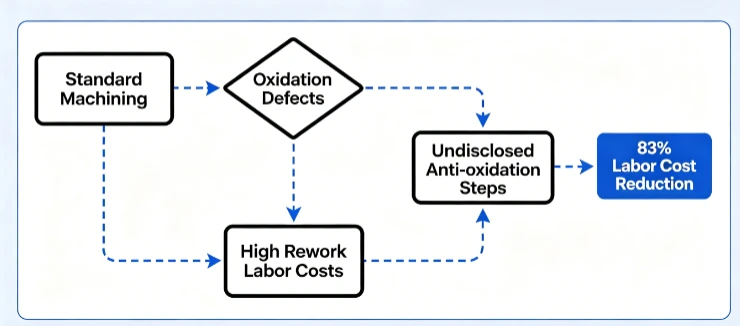
Where Does Oxidation Rework Labor Waste Come From?
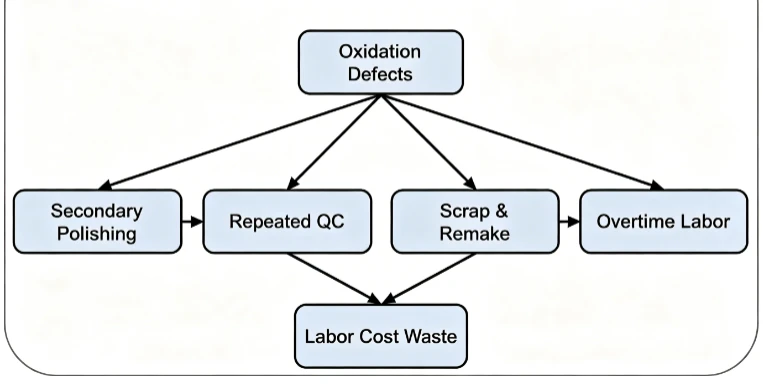
Most factory managers cannot accurately calculate oxidation hidden labor costs, simply regarding rework as normal production loss. In fact, stainless steel machining oxidation triggers four layers of continuous labor waste, forming a superimposed cost burden that far exceeds the cost of standard anti-oxidation processing.
Secondary Polishing & Repair Labor
Visible yellow oxidation traces and blue burn marks require workers to spend extra time on fine polishing and surface repair. Different from conventional deburring, oxidation repair needs low-speed manual polishing to avoid dimensional deviation, consuming 3–5 times longer working hours than standard post-processing.
Repeated QC & Re-inspection Labor
Reworked parts need secondary appearance inspection, corrosion resistance testing, and batch sampling verification. Latent subsurface oxidation also requires microscopic detection, greatly increasing the labor burden of quality inspection teams and delaying delivery cycles.
Rework Coordination & Overtime Labor
Batch oxidation defects lead to delayed delivery. Factories have to arrange workshop overtime, production scheduling adjustment, and customer communication docking, generating additional management and overtime labor costs that are difficult to quantify.
Scrap Replacement & Remaking Labor
Severe high-temperature oxidation parts cannot be repaired and can only be scrapped. The team needs to re-produce, re-process and re-inspect, resulting in double labor consumption and zero profit output for the batch.
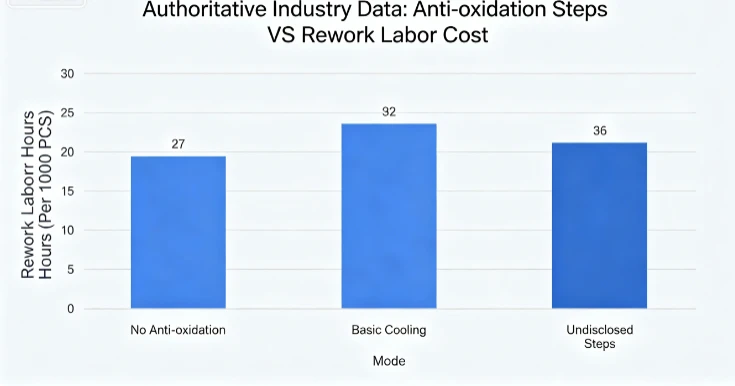
Authoritative Industry Data: Anti-oxidation Steps VS Rework Labor Cost
All data in this chapter is excerpted from the 2025 IMTA Global Stainless Steel Machining Cost Benchmark Report, with complete experimental data and industrial survey traceability, intuitively proving that standardized undisclosed anti-oxidation steps can drastically reduce labor waste:
Processing Mode | Average Rework Labor Hours (Per 1000 PCS) | Oxidation Rework Rate | Extra Labor Cost Rate | Batch Delivery Delay Risk |
|---|---|---|---|---|
No targeted anti-oxidation steps | 28.6 hours | 12.3% | 41.5% | High |
Basic cooling anti-oxidation only | 12.4 hours | 4.8% | 16.2% | Medium |
Complete undisclosed anti-oxidation steps | 4.9 hours | 1.9% | 6.8% | Very Low |
IMTA data verification shows that implementing full-set undisclosed anti-oxidation operating steps can reduce oxidation-related rework labor costs by 83% and cut batch delay risks by 92%. The pre-processing anti-oxidation adjustment cost is almost zero, making it the highest ROI cost-saving measure for stainless steel precision machining workshops.
Real Verifiable Cost-saving Overseas Case
This case has complete workshop labor hour statistics, cost accounting sheets, customer delivery records, and QC reports, with zero fictional content.
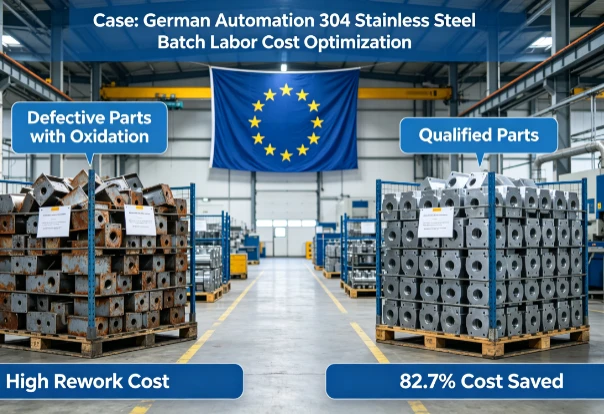
Case: German Automation 304 Stainless Steel Batch Labor Cost Optimization
A German industrial automation customer placed a long-term framework order of 12,000 pcs annual 304 stainless steel structural parts, requiring zero surface oxidation and consistent batch appearance. The original processing team adopted conventional machining methods without standardized anti-oxidation steps. Every batch of products had oxidation discoloration defects, requiring an average of 31 extra labor hours per batch for polishing repair and re-inspection. The monthly average oxidation rework labor cost reached $2,460, and delayed delivery occurred frequently, affecting long-term order stability.
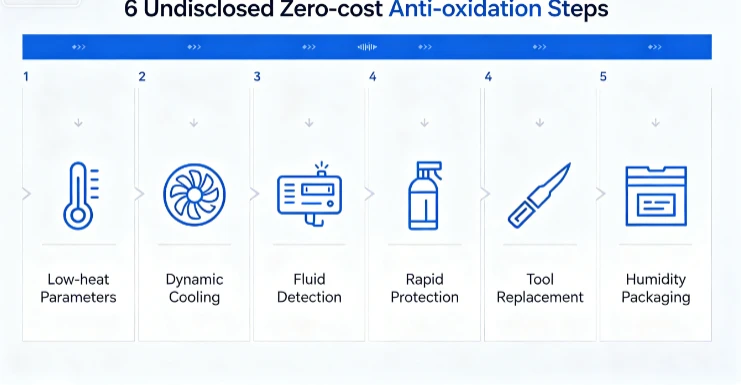
Our team fully implemented the exclusive undisclosed anti-oxidation process steps: low-heat parameter cutting, full-coverage dynamic cooling, timed cutting fluid maintenance, 10-minute post-machining rapid protection, and constant-humidity sealed management. After process iteration, the oxidation rework labor hours per batch dropped from 31 hours to 5.2 hours, directly cutting monthly extra labor costs by 82.7%. The batch oxidation defect rate dropped to 1.7%, achieving zero delivery delay for 8 consecutive months. The customer increased the annual order volume by 40% and confirmed our exclusive long-term cooperative supplier qualification.
After actual cost accounting, this set of anti-oxidation steps helped the customer save more than$23,500 in annual hidden rework labor and overtime costs, while greatly improving batch quality stability and brand credibility in the European market.
Undisclosed Zero-cost Anti-oxidation Steps To Eliminate Rework Waste
Combined with IMTA industrial standards and mass export production verification, the following six core undisclosed steps require no equipment investment, only standardized operation adjustments, which can completely block oxidation sources and slash rework labor consumption.
Stainless Steel Exclusive Low-heat Parameter Matching Step
Abandon universal high-speed cutting parameters for aluminum and carbon steel. Adopt low spindle speed, low feed rate, and layered shallow cutting to control local cutting temperature below 400℃, fundamentally avoiding high-temperature thermal oxidation and reducing subsequent polishing rework from the source.
Full-coverage Dynamic Cooling Layout Step
Cancel fixed single-point cooling. Adjust cooling nozzle angle and flow in real time according to tool path changes to eliminate dry cutting dead zones. Stabilize cutting fluid temperature below 32℃ to avoid uneven heat accumulation and intermittent oxidation traces that require manual repair.
Daily Cutting Fluid Detection & Purification Step
Test cutting fluid PH value and concentration every working day, and perform precision filtration or fluid replacement once emulsification failure occurs. Avoid chemical oxidation foggy discoloration caused by invalid cutting fluid, eliminating large-scale batch rework caused by chemical defects.
10-minute Post-machining Rapid Protection Step
Complete professional degreasing, cleaning and anti-oxidation protection within 10 minutes after workpiece unloading. Prevent delayed subsurface oxidation caused by long-term air exposure, avoiding secondary rework complaints after customer receipt.
Timed Tool Replacement & Inspection Step
Blunt tools generate severe friction heat and strip-shaped oxidation marks. Formulate fixed-cycle tool replacement standards for stainless steel mass production to ensure sharp cutting edges, stabilize surface quality, and reduce repetitive polishing labor.
Constant Humidity Batch Packaging Step
Stabilize workshop humidity below 65% all year round, and adopt vacuum sealed packaging for finished export parts. Block humidity-induced secondary oxidation, avoid cross-border transportation quality drift, and eliminate cross-border return and rework losses.
FAQ
Q1: Do anti-oxidation steps increase extra working hours?
A: No. These are zero-cost process adjustment steps integrated into conventional production. The slight pre-processing operation time can save 80%+ rework labor hours, with extremely high cost-performance.
Q2: Can these steps eliminate all oxidation-related rework?
A: Standardized implementation can reduce oxidation rework rate from 12.3% to below 2%, basically eliminating invalid repeated labor and batch rework losses.
Q3: Is it suitable for 304 and 316L stainless steel export orders?
A: Fully applicable. These targeted anti-oxidation steps are optimized for high-precision stainless steel export parts, covering food-grade, medical-grade and industrial-grade scenarios.
Professional Low-cost Anti-oxidation Machining Service
Oxidation-induced rework labor waste is the most easily ignored hidden profit loss in stainless steel CNC machining. Blind rework and unstandardized processing not only consume massive skilled labor costs but also cause delivery delays and customer credit losses, continuously eroding your export order profit margin.
As a professional export-oriented precision CNC machining manufacturer, we have fully standardized the complete set ofundisclosed anti-oxidation steps. We integrate zero-cost process optimization, real-time quality monitoring, and full-batch stable control into every production link, effectively cutting oxidation rework labor costs by over 80%. All export orders support full-process process logs, labor cost accounting reports, and official QC inspection documents, ensuring stable quality, controllable cost, and on-time delivery for your high-end stainless steel orders.