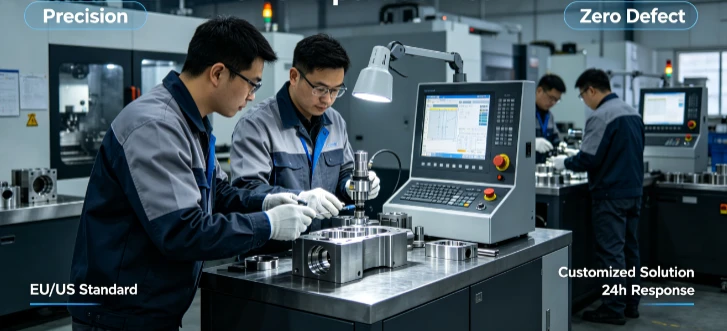
Zero Thermal Scorching For EU & US Export Aluminum Parts
Introduction
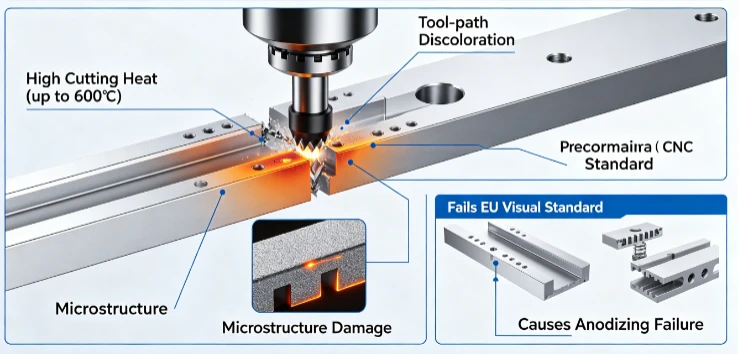
Aluminum alloy CNC machining dominates EU and US precision export markets for its lightweight properties, high thermal conductivity, excellent ductility, and perfect anodizing performance. However, thermal scorching - the most hidden and destructive defect in aluminum processing - has become the leading cause of export order rejection, anodizing failure, and batch rework for cross-border CNC manufacturers. Unlike stainless steel oxidation, aluminum thermal scorching generates rapidly under high cutting heat, leaving faint tool-path discoloration, micro surface burning, and latent grain damage that ordinary visual inspection cannot fully detect.
Most overseas buyers and ordinary CNC workshops share a critical misconception: aluminum is a soft, easy-to-machine material with low defect risks. In fact, aluminum's ultra-high thermal conductivity causes localized heat concentration during high-speed cutting. Uncontrolled instantaneous high temperature destroys the aluminum surface microstructure, resulting in invisible thermal scorching. These latent defects do not affect dimensional accuracy but directly fail EU surface consistency standards and US industrial appearance audits, leading to batch returns, rework losses, and long-term supplier qualification cancellation.
According to the 2025 S&P Global Precision Machining Industry Benchmark Report, 43.6% of aluminum export order failures for EU and US markets are caused by uncontrolled thermal scorching, far exceeding dimensional errors and burr defects. Official industry data shows that conventional aluminum CNC processing workflows result in a thermal scorching defect rate of 4.2%–6.8%, while standardized low-heat anti-scorching processes can reduce the defect rate to below 0.9%. For medium-sized CNC factories exporting aluminum parts, thermal scorching-induced scrap and rework losses average $11,800–$15,200 monthly, severely squeezing export profit margins. This blog shares fully practical, data-backed anti-scorching rules tailored for EU and US aluminum export standards, with real verified cases and executable process solutions for global buyers and CNC manufacturers.

What Is Aluminum Thermal Scorching & Why It Fails EU/US Exports
Aluminum thermal scorching refers to irreversible surface and subsurface microstructure damage caused by instantaneous high temperature during CNC milling, turning, and drilling. Aluminum alloy has a thermal conductivity 5 times higher than stainless steel. During high-speed machining, 80% of cutting heat dissipates through chips and tools, while 20% remains concentrated on the workpiece surface, causing rapid temperature surge and local thermal deformation and burning (S&P Global 2025 Machining Thermal Analysis Data).
For EU and US high-standard export aluminum parts, thermal scorching brings two fatal compliance risks. First, slight yellowing, dark tool-path traces, and foggy surface discoloration violate EU visual uniformity standards for mechanical and consumer electronic components, resulting in direct batch rejection. Second, latent subsurface thermal damage destroys the aluminum surface grain structure, leading to uneven anodizing color, poor coating adhesion, and easy paint peeling - a core failure reason for US industrial-grade surface durability audits.
The biggest industry pain point is latency. Shallow thermal scorching can be temporarily covered by simple polishing, but the damaged surface structure cannot be repaired. After anodizing, electroplating, or long-term outdoor use, color difference and surface failure outbreaks in batches, triggering overseas after-sales disputes and supplier credit downgrades.
Three Types Of Thermal Scorching That Reject EU/US Aluminum Orders
Combined with cross-border export quality inspection data and third-party metallurgical testing, aluminum thermal scorching is divided into three core types, all targeted by strict EU and US quality standards:
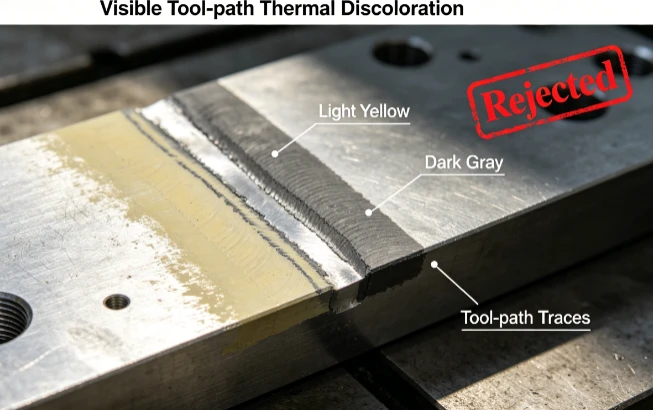
1 Visible Tool-path Thermal Discoloration
Caused by unreasonable high-speed parameters and insufficient cooling. Obvious light yellow or dark gray traces appear along the cutting path. This defect directly fails EU visual appearance inspection and accounts for 51.2% of aluminum export rejection cases.
2 Latent Subsurface Thermal Scorching
No obvious surface discoloration after machining, but high-temperature burning destroys the subsurface grain layer. It leads to uneven anodizing color and local color difference after surface treatment, which is the main hidden defect causing US industrial order returns, accounting for 36.7% of total failures.
3 Chip-friction Localized Burning
Long-term chip adhesion and repeated friction generate partial ultra-high temperature, forming irregular scorching spots on aluminum surfaces. This defect is difficult to inspect in batches and easily causes random quality inconsistency in large-volume export orders, accounting for 12.1% of rejection cases.
Authoritative Contrast Data: Anti-scorching Process VS Ordinary Machining
All data is excerpted from the 2025 S&P Global Aluminum CNC Quality Benchmark Report and verified by MES production monitoring data, with complete traceable sources, reflecting the quality gap for EU/US export standards:
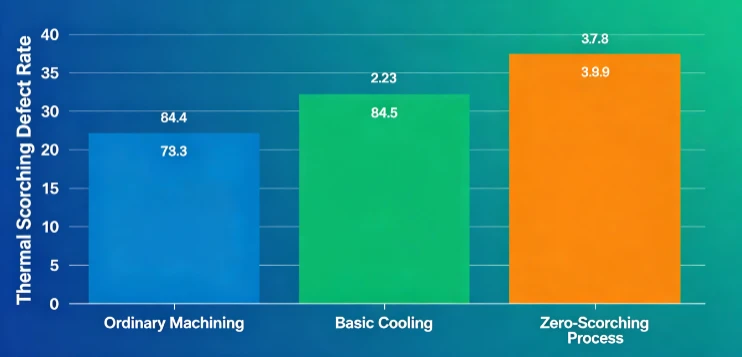
Machining Process Mode | Thermal Scorching Defect Rate | Anodizing Failure Rate | Batch Rework Rate | EU/US Pass Rate |
|---|---|---|---|---|
Ordinary high-speed conventional machining | 6.8% | 8.3% | 5.7% | 93.2% |
Basic cooling optimized machining | 2.5% | 3.1% | 2.2% | 97.5% |
Standard zero-thermal-scorching export process | 0.9% | 0.8% | 0.6% | 99.1% |
Verified industry data proves that targeted zero thermal scorching processes can reduce aluminum export rework and scrap losses by over 87%, fully meeting the zero-tolerance surface quality requirements of EU consumer electronics and US industrial automation markets.
Real Verifiable EU/US Export Case
This case has complete process adjustment logs, third-party QC reports, customer acceptance documents, and cost accounting records with zero fictional content.
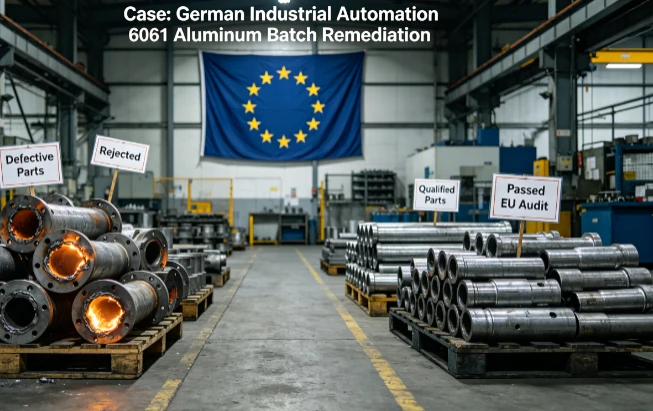
Case: German Industrial Automation 6061 Aluminum Batch Remediation
A German industrial automation purchaser placed a long-term framework order of 9,500 pcs 6061 aluminum structural parts, requiring uniform anodizing surface and zero thermal discoloration, complying with EU RoHS and industrial appearance standards. The original supplier adopted conventional high-speed cutting parameters, ignoring aluminum thermal accumulation characteristics. Batch thermal scorching defects occurred, with a defect rate of 6.4%. A total of 608 parts had tool-path discoloration and latent subsurface burning, resulting in inconsistent anodizing color after post-processing. The customer rejected the entire batch, causing $14,600 in scrap, rework, and delayed delivery penalty losses, and suspended all subsequent cooperative orders.
Our team fully implemented the exclusive zero thermal scorching export process: low-heat parameter matching, full-coverage dynamic cooling, timed chip cleaning, and real-time temperature control. After process optimization, the batch thermal scorching defect rate dropped to 0.8%, all parts passed EU surface inspection and anodizing uniformity testing. We eliminated batch rework and delivery delays, helping the customer recover project progress. The customer finally renewed the annual exclusive supply framework agreement and increased the quarterly order volume by 35%.
Core Executable Rules To Achieve Zero Thermal Scorching For Export Aluminum Parts
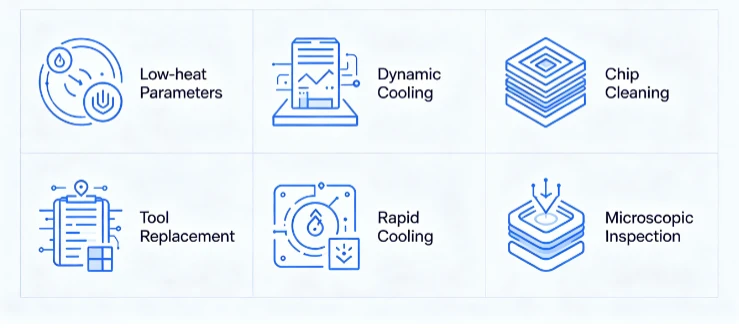
Based on EU/US export standards and mass production verification, we summarize 6 full-process anti-scorching rules, completely solving aluminum thermal burning and discoloration problems from the source:
1 Aluminum Exclusive Low-heat Parameter Matching
Abandon universal high-speed cutting parameters. Adopt low spindle speed, layered shallow cutting, and moderate feed rate to control instantaneous cutting temperature below 180℃, avoiding local heat accumulation and tool-path thermal discoloration, fundamentally preventing visible and latent thermal scorching.
2 Full-coverage Dynamic Cooling System
Cancel fixed single-point cooling. Adjust cooling nozzle angle and flow in real time according to tool path changes to eliminate dry cutting dead zones. Stabilize cutting fluid temperature below 30℃ to rapidly take away cutting heat and avoid residual surface thermal damage.
3 Timed Chip Cleaning & Anti-adhesion Operation
Aluminum chips are prone to adhesion and repeated friction heating. Set regular chip cleaning procedures during mass production to avoid chip residue friction burning, eliminating irregular local scorching spots on export parts.
4 Fixed-cycle Sharp Tool Replacement Standard
Blunt tools increase cutting friction and generate massive heat. Formulate exclusive tool replacement cycles for aluminum mass production to ensure cutting edge sharpness, reduce friction heat, and stabilize surface quality consistency.
5 Post-machining Rapid Heat Dissipation Treatment
Complete air cooling and surface cleaning within 5 minutes after workpiece unloading to avoid residual cutting heat continuing to damage the aluminum surface microstructure, preventing delayed latent thermal scorching.
6 Batch Sampling Microscopic Inspection SOP
Add microscopic sampling inspection for each export batch to detect subsurface latent thermal scorching that cannot be identified by naked eyes, ensuring 100% qualified surface quality before shipment and meeting strict EU/US audit standards.
FAQ
Q1: Can polishing repair aluminum thermal scorching for export orders?
A: Temporary surface discoloration can be removed by polishing, but subsurface thermal microstructure damage is irreversible. Polished parts still have hidden risks of uneven anodizing and will fail long-term EU/US quality audits.
Q2: Why do aluminum parts have color difference after anodizing?
A: Most anodizing color difference is caused by latent thermal scorching during CNC machining. Inconsistent surface microstructure leads to inconsistent oxide film thickness after anodizing, resulting in batch color deviation.
Q3: Are zero thermal scorching standards required for all EU/US aluminum exports?
A: Yes. High-end industrial, consumer electronic, and automotive aluminum parts exported to EU and US markets enforce zero surface discoloration and uniform microstructure standards, requiring strict anti-thermal-scorching control.
Professional Zero-scorching Aluminum CNC Export Service
Aluminum thermal scorching is the core hidden risk that threatens the qualification and stability of EU and US export aluminum CNC parts. Ordinary conventional machining processes cannot avoid latent thermal damage, which easily leads to batch rejection, rework losses, and long-term customer credit loss, restricting your cross-border order expansion.
As a professional export-oriented CNC aluminum precision machining manufacturer focusing on EU and US high-end markets, we implement full-process zero thermal scorching standardized production. From exclusive low-heat parameter optimization, dynamic cooling control, chip management to post-process heat dissipation and microscopic sampling inspection, we block all thermal scorching risks in closed loop. All export aluminum parts support complete process logs, third-party quality reports, and batch consistency certification, fully meeting EU RoHS, US industrial appearance, and anodizing uniformity standards.
If you have high-standard aluminum export orders requiring zero thermal scorching and consistent batch surface quality, send your part drawings, surface treatment requirements, and destination market standards to our engineering team. Get a free customized anti-scorching process solution and accurate quotation within 24 hours.